
It is unacceptable for a president to issue pardons to family members
Democrats68%
Republicans65%
Independents66%
Source: YouGov, Apr. 25, 2025
Chart: Americans Agree
Chart: Americans Agree
How a Constitutional power lost its limits
The Founders designed the presidential pardon as a rare act of mercy, relying on norms of restraint rather than formal legal limits to its use.
Over the past 25 years, presidents have increasingly used pardons and commutations for political or strategic purposes, eroding those norms.
The Biden and second Trump administrations accelerated the trend, including in ways that ran counter to cross-party public opinion.
Because the pardon power is granted by the Constitution, there is no easy legal fix—only the possibility that today’s excesses may eventually provoke a return to restraint.
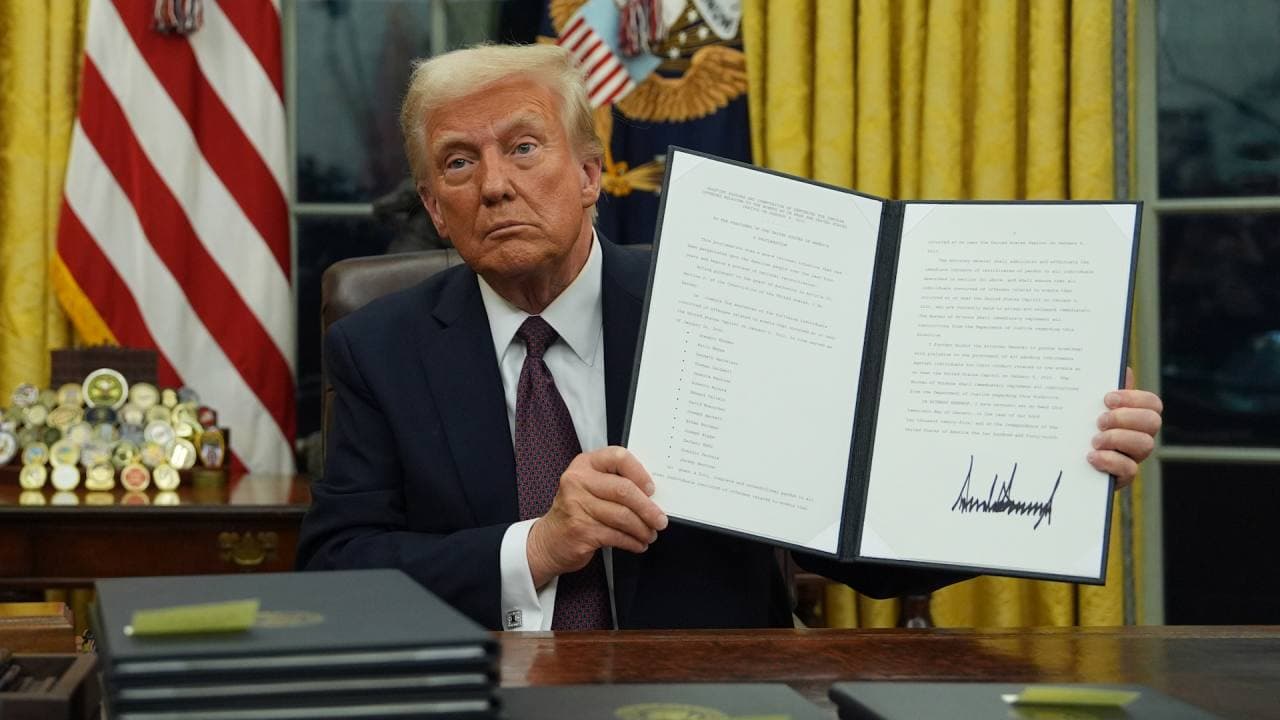
President Trump signs pardons for January 6 defendants in January 2025. Image by The Wall Street Journal.
Across party lines, Americans have been increasingly leery about the use of the presidential pardon. Near the end of his presidency, Joe Biden not only pardoned his son Hunter but also issued preemptive pardons against potential future charges to various allies inside and outside his administration. Shortly after, Donald Trump retook office and issued sweeping pardons and commutations for those convicted in relation to the January 6, 2021 Capitol riot. Since then, Trump has issued a regular stream of pardons, many to political allies and financial contributors.
Is this just politics as usual, or has something important changed about presidential pardons?
The short answer is something changed in 2001 and has been getting worse since. Presidents of both parties have played roles, each in different ways.
As a topic, presidential pardons involve three words that mean similar but different things:
A pardon forgives a federal crime and removes its legal consequences. It does not declare the person innocent, but it ends punishment and can restore civil rights such as the ability to vote or hold office.
A commutation reduces or ends a criminal sentence without erasing the conviction itself. The person remains legally guilty, but serves less—or none—of the original punishment.
Clemency is the general term for acts of mercy by the president, including pardons, commutations, and other less common forms of sentence relief.
In normal use, presidential pardon often broadly refers to all of the above.
Substantial cross-party majorities are against presidential pardons for family members:
| Question | Do you generally consider the following actions by a U.S. president to be...? |
| Item | Issuing pardons to family members |
| Response | Unacceptable |
| Poll Main Page | Americans say many Trump tactics cross the line for presidents |
| Interview Period | Apr. 21, 2025 to Apr. 24, 2025 |
| Sample Size | 1,168 |
| Policy Context | When this poll was conducted in April 2025, President Joe Biden had pardoned his son, Hunter, several months earlier, before the elder Biden left office. Hunter Biden had pled guilty to tax charges in September 2024 and was found guilty of being an illegal drug user in possession of a gun in June 2024. Joe Biden’s justification for the pardon was that he believed Hunter had been treated unfairly because of being the president’s son. |
| Insight | |
| Share Link | Pardons : YouGov, Apr. 25, 2025 |
Another question from the same poll asked about pardons for political allies. 81% of Democrats, 65% of Independents, and 48% of Republicans were against. Notably, Republicans had an unusually high “Unsure” percentage: 30%, whereas 22% of Republicans thought pardons for political allies were acceptable (Independents and Democrats were much lower still).
This is a consistent pattern in poll questions about recent Trump pardons: Democrats and Independents were strongly against, and Republicans were split three ways (against, support, unsure) with “against” having the greatest share.
For example, in a December 2025 poll by The Economist / YouGov, the pattern appeared in responses to all three questions about recent Trump pardons (quotes are from the poll questions’ wording):
“Former Honduran President Juan Orlando Hernandez, who in 2024 was convicted of drug trafficking and sentenced to 45 years in prison”
“Texas Democratic Representative Henry Cuellar and his wife, who had been charged with accepting $600,000 in bribes”
“David Gentile, who had been convicted of a $1.6 billion financial fraud and had served two weeks of a seven-year prison sentence”
The takeaway is, cross-party resistance was significant against Biden’s pardon of his son, Hunter, as well as numerous Trump pardons that have made news.
It’s worth pausing to ask how we got here. A president’s pardon power goes back to America’s Founders and is part of Article II, Section 2 of the United States Constitution. That section authorizes the president to grant “reprieves and pardons for offenses against the United States, except in cases of impeachment.”
Alexander Hamilton defended the concept in Federalist No. 74. Laws, he argued, must be general and courts must apply them rigidly. Circumstances sometimes warrant a human’s judgment that no statute can anticipate. The president, Hamilton believed, was better positioned to exercise that judgment than a legislature or committee, and would be accountable to voters in case of misuse.
The first use of the presidential pardon was illustrative: After the government put down the Whiskey Rebellion, President Washington pardoned the two participants who had been convicted and sentenced to death. He described the pardons as an act of “moderation and tenderness” applied after firm enforcement against revolt.
The Founders did not imagine the pardon as a routine political instrument or as a reward for loyalty. They assumed it would be used sparingly, publicly, and with an understanding that abuse would carry reputational and political costs.
For most of American history, this assumption held. Although there were cases of dubious pardons, they were exceptions, not the rule. Most presidents issued few pardons, and avoided obviously self-interested uses, such as for family members or close associates.
The most famous presidential pardon further illustrates the original spirit: In 1974, President Gerald Ford pardoned former President Richard Nixon for any acts related to the Watergate scandal. Ford said that Nixon had already suffered total disgrace, and further prosecution would be an extended, distracting circus that would further divide and distract the country. Ford’s decision can be debated, but it’s clearly the kind of situation the Founders imagined.
Many observers point to a particular pardon as the symbolic onset for the current era’s controversy over pardons. On his final day in office in 2001, Bill Clinton pardoned financier Marc Rich. This pardon broke sharply with prior norms in several ways.
Rich was a fugitive from U.S. justice, having fled the country after being indicted on dozens of counts including tax evasion, wire fraud, and illegal trading with Iran during the hostage crisis.
Rich’s ex-wife had made substantial donations to Democratic causes and the Clinton presidential library.
Unlike most clemency recipients, Rich had not served any sentence, expressed remorse, or submitted to U.S. courts.
The pardon bypassed the Justice Department’s ordinary review process, which traditionally screens applications through the Office of the Pardon Attorney.
No detailed public justification accompanied the pardon at the time, and when defenses were later offered, they focused largely on the president’s constitutional authority to grant clemency rather than on why this case merited relief.
Earlier controversial pardons existed, but the Rich case crystallized several anxieties at once: last-minute action immune from political accountability, circumvention of institutional safeguards, and perceived rewards for wealth or connections. Although public reaction was negative, the news cycle quickly moved on. Investigations occurred, but no formal consequence resulted.
Separate from Marc Rich–style pardons, Presidents Barack Obama and Joe Biden opened another front of pardon power by dramatically expanding clemency through mass commutations, particularly for drug offenses. Whereas prior presidents typically commuted dozens of sentences, Obama commuted 1,715 cases and Biden commuted 4,165.
Obama’s commutations focused on people serving long federal sentences under pre-2010 crack-cocaine laws. Biden issued sweeping commutations for nonviolent drug offenders and granted sentence reductions to entire classes of individuals at once, including reducing the sentences of nearly all prisoners on federal death row to life in prison. Although grantees were formally reviewed and screened for eligibility, the defining feature of these programs was their reliance on broad categorical criteria rather than individualized moral judgment.
Unlike the Marc Rich model, mass-clemency actions were not personally self-serving for the presidents involved. Some actions were justified as retroactively aligning sentences with laws Congress had since amended or repealed. But ultimately Obama’s and Biden’s mass clemencies helped normalize commutations as broad executive tools rather than rare exceptions for individual cases. In doing so, clemency increasingly functioned as a mechanism for achieving policy outcomes beyond Congressional actions.
In addition to his mass commutations, Joe Biden issued several unusually broad, preemptive pardons. In his final hours in office, he granted “full and unconditional” pardons to figures such as White House medical advisor Dr. Anthony Fauci and Chairman of the Joint Chiefs of Staff Mark Milley, as well as members and staff of the January 6 committee. The pardons were anticipatory: They were designed to block any future attempts to charge the recipients with federal crimes associated with their government service.
Separately, Biden pardoned his son Hunter with a sweeping pardon covering offenses Hunter “has committed or may have committed” from 2014 through December 1, 2024—language broad enough to reach beyond the gun and tax cases then at issue, though it did not extend to future conduct.
Biden framed his preemptive pardons as defensive acts to prevent the justice system from being used as a tool of retaliation. This move expanded clemency from a mechanism for righting past wrongs to an insurance policy against future administrations’ actions. But a power justified as protection against weaponized justice can just as easily be invoked to shield allies from accountability to non-weaponized justice.
Donald Trump, especially in his second term, has taken the Marc Rich model to another level. More openly than any predecessor, he has treated clemency not as an exceptional act of mercy but as a routine political instrument—used to reward loyalty and donations, signal protection, and normalize the expectation that allies will be shielded from legal consequences.
For example, in April 2025 Trump pardoned Paul Walczak under circumstances that drew scrutiny. A former nursing-home executive, Walczak had pleaded guilty to federal tax charges, been sentenced to 18 months in prison, and ordered to pay $4.4 million in restitution. The pardon was issued days before Walczak was required to begin serving his sentence and pay the restitution order, effectively relieving him of both penalties. Notably, the pardon came roughly three weeks after Walczak’s mother, Elizabeth Fago, attended a $1 million-per-plate fundraising dinner for Trump. Fago had also previously supported Trump through other political and philanthropic channels—connections that Walczak himself cited in arguing that he had been unfairly targeted by the Biden administration.
In his first year back in office, Trump issued a steady stream of pardons like this, many of which flaunt rather than avoid the appearance of impropriety. In this new environment, a pardon economy of consultants and lobbyists has emerged.
Finally and most notable, in January 2025 Trump issued sweeping pardons and commutations of defendants convicted in connection with the 2021 Capitol riot. Trump defended the move by claiming the defendants were politically persecuted, but most had been convicted through the ordinary federal criminal process, including jury trials or guilty pleas before independent courts.
Trump’s Capitol riot pardons were unique because they combined the mass clemency of recent presidents with Trump’s expansion of transactional, loyalty-based pardons. The grants included individuals convicted of assaulting police officers, obstructing the certification of the presidential election, and participating in organized efforts to disrupt the peaceful transfer of power. In effect, the pardon power was used not to correct individual injustices based on specific circumstances, but to retrospectively legitimize a political cause, without differentiating between marginal cases and defendants convicted of serious offenses. This was far removed from anything the Founders envisioned.
Given public concern about pardons, what can be done? Obvious remedies exist, such as preventing pardons of family members, associates, or funders; banning preemptive pardons; and disallowing pardons in the final months of a presidential term, when there is little accountability to voters.
But because the president’s pardon power is explicitly authorized by the Constitution, these remedies would need to be enacted by a Constitutional amendment—a long and difficult process that was last completed successfully in 1992.
Although Congress cannot by itself limit the power of presidential pardons, Congress can regulate adjacent areas:
Transparency requirements, such as public explanations or disclosure of advisory recommendations
Funding and structure of advisory bodies within the executive branch.
Criminal penalties for bribery, corruption, or false statements connected to pardon requests
These measures could raise the political and legal costs of pardon abuse, but their value is questionable in a world where presidents have learned—through cases like Marc Rich and Trump’s transactional pardons—that even the most brazen uses of clemency may carry few lasting consequences.
The original concept for the presidential pardon was reasonable, even noble. But it was based on trust that the president would not abuse the power, or if they did, they would face such reputational costs to ward-off others from pursuing the same path.
For hundreds of years, the trust mostly worked. But for the past twenty-five years, it has worked less and less, at a seemingly increasing rate of dysfunction. This is what public opinion is reacting to.
If public concern about aggressive pardoning reaches a breaking point, there may be space for restraint to return; the era of transactional pardons, preemptive pardons, and mass commutations could come to be viewed as an unusual period of excess. But for now, it’s an open question whether the presidential pardon can return to its roots, or will continue devolving into just another lever of power.