
The federal government should increase spending on veterans
Democrats77%
Republicans81%
Independents65%
Source: The Economist/YouGov, Nov. 24, 2025
Chart: Americans Agree
Chart: Americans Agree
Has broad public support translated to results?
Americans across parties lines have long supported government spending increases for veterans.
Federal spending on veterans doubled over the past decade, driven largely by long-term obligations and aging veteran populations rather than new policy choices.
In addition to covering existing obligations, the spending increase has coincided with improvements in veterans homelessness and aspects of healthcare quality.
The 2022 PACT Act brought a clear expansion of benefits but raised concerns about long-term cost growth and entitlement design.
The Department of Veterans Affairs continues to face challenges with bureaucracy, staffing reductions, and claims processing, even as some performance metrics improved in 2025.

Image: David Valentine / Unsplash
Few things unite Americans across party lines like support for veterans, both in public opinion and in Congress. What is less widely understood is how fast veterans’ spending has been growing, and whether that growth is actually achieving what the public wants.
In the past ten years, federal spending on veterans roughly doubled to about $370 billion in 2025, an extraordinary increase to what was already one of the federal government’s largest agencies. Much of that growth came not from new political choices, but from the rising cost of fulfilling long-standing obligations to former service-members.
From that, an obvious question arises: Has the increased spending done what public opinion clearly wants—meaningful improvement to the lives of veterans, particularly those in need—or was it necessary simply to maintain the status quo, as Vietnam-era veterans reach their most expensive years of support and a new generation of post-9/11 veterans add costs to the system?
Here is the most recent poll Americans Agree has on the subject:
| Question | Do you think the federal government should increase or decrease what it spends on...? |
| Item | Veterans |
| Response | Increase slightly or a lot |
| Poll Main Page | The Economist/YouGov Poll, Nov. 24, 2025 |
| Interview Period | Nov. 21, 2025 to Nov. 24, 2025 |
| Sample Size | 1,677 |
| Earlier results | 2 earlier poll results [see all] |
| Policy Context | When this poll was conducted in late November 2025, the House and Senate still needed to reconcile their spending bills, but the Department of Veterans Affairs had asked for a 10% budget increase from 2025 to 2026. The reconciled amount is likely to prove that or more. The Department is currently in the process of reducing its workforce 30,000 employees, mostly through not filling roles vacated by people who resigned or retired. |
| Share Link | Veterans Spending : The Economist/YouGov, Nov. 24, 2025 |
This result is not an outlier. Cross-party majorities have long supported greater government spending for veterans:
Republicans who are normally wary of increases to social spending often make an exception for programs that help veterans.
Democrats who are otherwise wary of increases related to the military often make an exception for veterans.
Politicians rarely miss an opportunity to present themselves as champions of veterans.
Consistent with these sentiments, the past decade has seen big budgetary increases for the U.S. Department of Veterans Affairs (VA), as indicated by this chart and table from the VA:
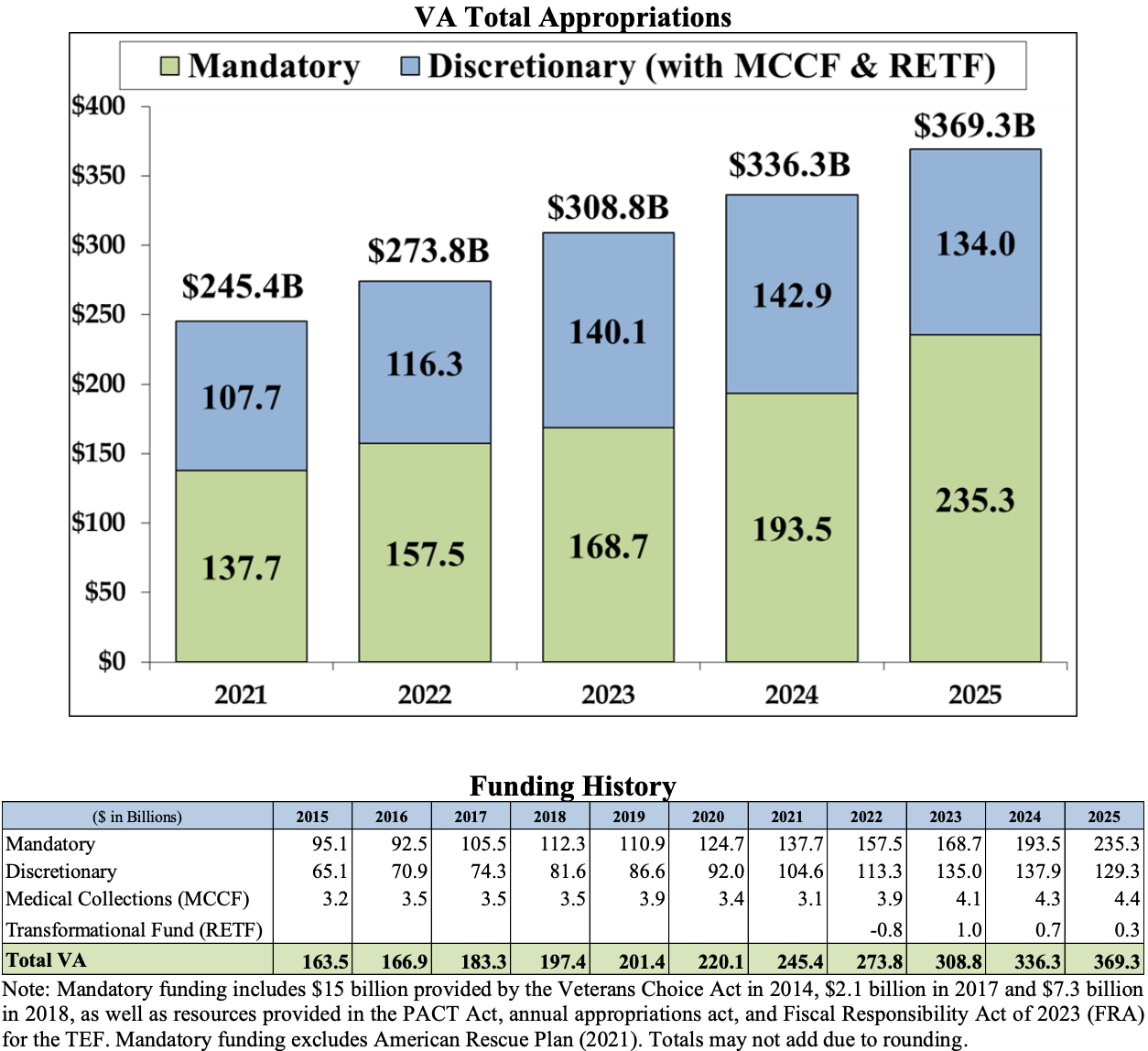
(In the chart, “mandatory” spending covers benefits that are legally owed, such as disability compensation, pensions, and survivor benefits. But even “discretionary” spending has limited flexibility in practice: It largely reflects the cost of delivering health care to eligible veterans, which tends to rise due to medical cost inflation.)
If from the chart you conclude that things must be a lot better for the average veteran-in-need in 2025 than in 2015, it’s not that simple.
A doubling of veterans’ spending would seem to be an unmistakable policy choice. In reality, much of the growth was already baked in.
Veterans’ benefits are dominated by long-term commitments that play out slowly over time. Disability compensation, pensions, survivor benefits, and health care costs typically rise decades after service ends, as injuries worsen with age and chronic conditions become more expensive to treat. Even without any major new legislation, these obligations tend to grow automatically as eligible veterans age into periods of higher need.
At the same time, the needs of the veteran population have been shifting. Vietnam-era veterans are now reaching the most costly years of medical support, and veterans of the post-9/11 wars in Iraq and Afghanistan are adding to the system.
Taken together, these forces mean that much of the growth in veterans’ spending reflects the delayed cost of past military service, not a series of Congressional decisions to expand benefits. In that sense, rising spending was less a choice than a consequence.
So has all the extra money simply allowed support of veterans to not get worse, or has it gotten better in some ways? There is evidence that at least some of the increased spending has translated into meaningful improvements for veterans.
One of the clearest success stories is veteran homelessness. Over the past decade, the number of veterans experiencing homelessness has fallen substantially compared to the overall homeless population. Expanded programs that combine housing assistance with supportive services—often coordinated by the VA—are widely credited with driving those gains. This is an area where increased funding appears closely tied to improved outcomes.
Research comparing VA healthcare to private-sector care often finds that the VA performs as well as or better than non-VA providers on many quality measures, particularly for complex or chronic conditions. The VA’s integrated health system and electronic records have been cited as strengths, and some studies suggest that VA care delivers comparable outcomes at lower overall cost for high-need patients.
The 2022 PACT Act represents a clear case where increased spending was explicitly aimed at improving veterans’ lives. It removed the requirement that veterans individually document a connection between their military service and a toxic exposure, such as Agent Orange in Vietnam or burn pits in Iraq. Instead, the law presumes toxic exposure for veterans who served in specific locations during specified periods. For a defined list of illnesses, it also presumes those conditions are service-connected.
Supporters view this as a necessary correction for harms that were difficult or impossible to document years after service. Critics argue that the breadth of these presumptions effectively turns large categories of common medical conditions into automatic entitlements.
Leaving aside the debate about whether it is too entitling, PACT was a rare case of what many people intuitively think about as increasing support for veterans—in this case, making it easier to qualify for care and compensation. From a budgeting perspective, it stands out as a case of substantially adding to long-term obligations rather than increasing spending primarily to cover existing obligations.
Despite rising spending, the VA continues to face challenges.
Veterans’ advocates report frustration with disability claims processing and appeals, noting that procedural inefficiencies can result in long delays and, at times, temporary underpayment or denial of benefits. While the number of backlogged cases has improved substantially in 2025, higher spending has not eliminated the VA’s reputation as a case study of complex government bureaucracy.
As part of the Trump administration’s government-efficiency initiative, the VA shed 30,000 jobs in 2025, largely through attrition, early retirements, resignations, and a federal hiring freeze. This has drawn criticism from unions and some lawmakers, who warn that reducing staff while increasing benefits will strain the ability to deliver those benefits.
Supporters of the reductions argue that staffing levels had grown unsustainably during the pandemic, and that the VA has successfully done more with less throughout 2025. VA leaders note that even as workforce numbers declined in 2025, the agency achieved major reductions in the backlog of claims.
Veterans’ spending illustrates a broader truth about government programs built on long-term obligations: Rising budgets do not automatically mean expanding services or better outcomes. In many cases, they reflect the cost of keeping promises made long ago to a population whose needs are changing—although as seen above, there are areas where additional funding has produced new, positive results.
Looking ahead, spending on veterans is almost certain to continue increasing and to remain politically protected. The uncertainties will center on how that money is used, as illustrated by 2025’s attempt to reduce administrative headcount even as benefits expanded, or by lingering questions about whether PACT expanded benefits too broadly. The central test will continue to be whether spending growth delivers outcomes that match the spirit of the broad public consensus on veterans.