
The U.S. government should have a major role in providing aid to communities in the aftermath of natural disasters
Democrats87%
Republicans80%
Independents72%
Source: Associated Press-NORC, Jun. 20, 2025
Chart: Americans Agree
Chart: Americans Agree
As Trump targets FEMA, what will happen to disaster aid?
Federal disaster aid enjoys broad bipartisan public support. The Federal Emergency Management Agency (FEMA) does as well, though less than for disaster aid itself.
President Trump has proposed dismantling or diminishing FEMA, but the president lacks the legal authority to abolish the agency or redirect its funding unilaterally.
The administration has instead used the levers it controls to reduce FEMA staff and introduce new management controls, with the assumption that states will take more responsibility.
All sides see reform as necessary, but the current path risks a readiness gap as existing federal capabilities are weakened without a coordinated buildup of state-level capacity.
Congress is pursuing a bipartisan alternative, the FEMA Act, that seeks to reform how FEMA operates rather than dismantling it.
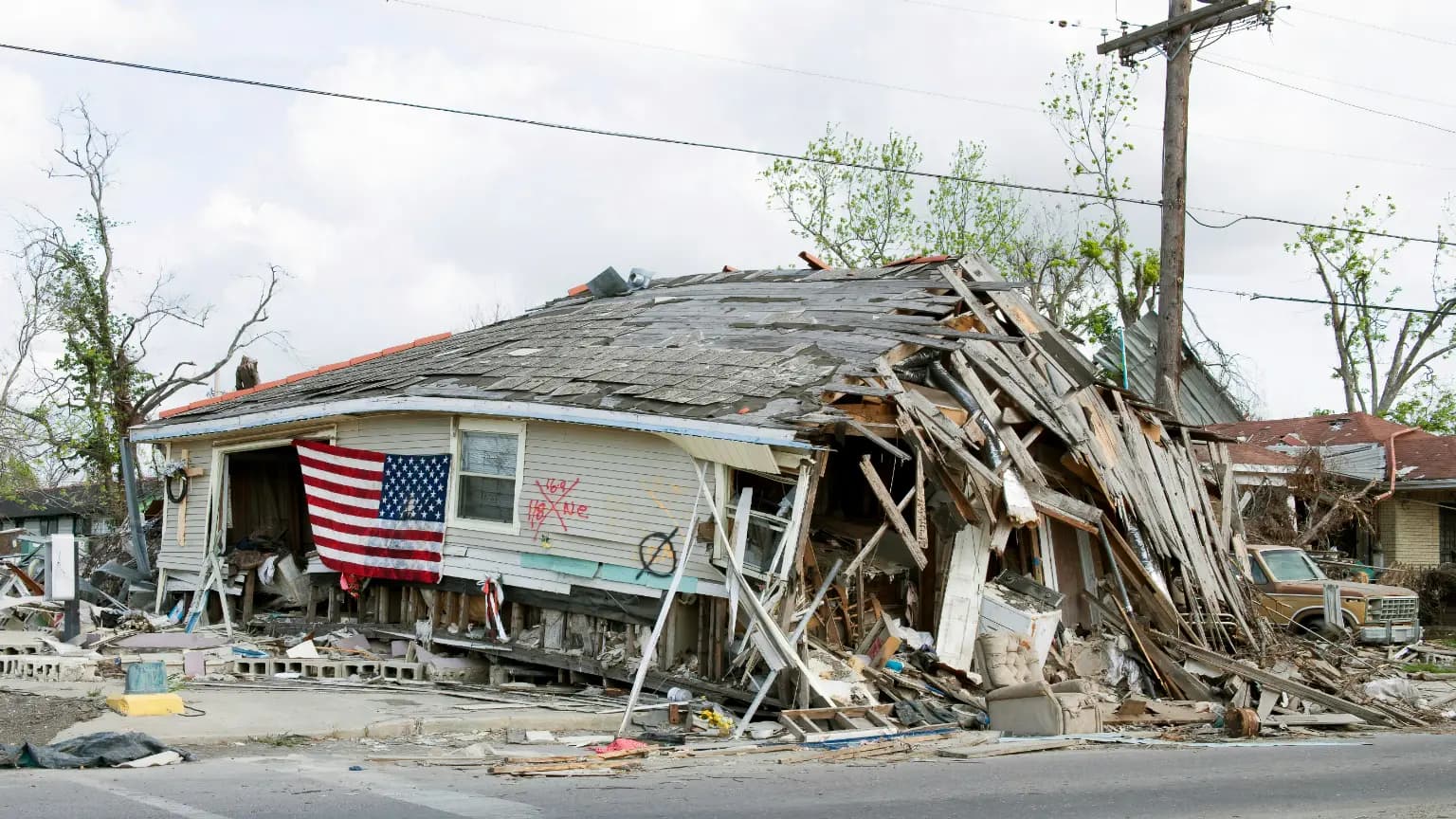
Destruction from Hurricane Katrina, New Orleans, 2005. Image: Library of Congress.
Federal disaster aid is a government function with broad cross-partisan support, both in Congress and public opinion. When a major natural disaster strikes, people have come to expect the federal government to fund and coordinate aid beyond what state and local governments can provide. FEMA (Federal Emergency Management Agency) is the federal agency primarily responsible. Although past presidents have criticized FEMA’s responses to particular disasters, President Trump is the first president to suggest he might “get rid of” FEMA altogether. How real is this threat, and what would it mean for disaster aid?
Large majorities of Democrats, Republicans, and Independents believe “the U.S. government should have a major role in providing aid to communities in the aftermath of natural disasters.”
| Question | How much of a role should the U.S. government have in the following? |
| Item | Providing aid to communities in the aftermath of natural disasters |
| Response | Major role |
| Poll Main Page | Declines in public support for green and renewable energy |
| Interview Period | Jun. 5, 2025 to Jun. 9, 2025 |
| Sample Size | 1,158 |
| Earlier results | 1 earlier poll result [see all] |
| Policy Context | When this poll was conducted in June 2025, the Trump Administration had made numerous cuts to the Federal Emergency Management Agency and was considering eliminating the agency altogether. This would put the burden of disaster relief entirely on states. |
| Insight | |
| Share Link | Aid after Disasters : Associated Press-NORC, Jun. 20, 2025 |
When asked whether FEMA’s budget should be expanded, kept the same, or reduced, cross-partisan majorities say it should not be reduced (that is, they answered it should be expanded or kept the same).
| Question | Do you think that the following government agencies should be expanded, reduced, or kept about the same? |
| Item | Federal Emergency Management Agency (FEMA) |
| Response | Expanded or kept the same |
| Poll Main Page | Disapproval of Trump, bipartisanship on Epstein, shift on Russia interference, the EPA, and tariffs |
| Interview Period | Jul. 25, 2025 to Jul. 28, 2025 |
| Sample Size | 1,777 |
| Policy Context | When this poll was conducted in late July 2025, the Trump Administration had made numerous cuts to the Federal Emergency Management Agency and was considering eliminating the agency altogether. This would put the burden of disaster relief entirely on states. Disaster relief was prominent in the news due to a major flood in Texas earlier in July. |
| Insight | |
| Share Link | Funding for FEMA : The Economist/YouGov, Jul. 29, 2025 |
In the charts, Republican support is significantly lower for FEMA (56%) than for the concept of federal disaster aid (80%). This difference reflects long-standing skepticism among some Republicans toward federal agencies, plus Donald Trump’s recent attacks on FEMA.
In Trump’s first term (2017–2021), he largely accepted FEMA’s role and occasionally praised it amid criticism. For example, when Hurricane Maria hit Puerto Rico in 2017, aid was slow to arrive, but Trump later declared the response “a 10” out of 10.
At the same time, Trump’s support was often transactional and contentious: He repeatedly criticized the scale and management of disaster aid, especially to Puerto Rico, and floated withholding aid from states over unrelated policy disputes.
But during the 2024 presidential campaign, when Hurricane Helene struck in September 2024, then-candidate Trump used the moment to sharply criticize FEMA under President Biden. Trump asserted, among other things, that the agency was withholding aid from Republican-leaning areas, failing to deploy rescue helicopters for Helene, and diverting disaster funds to undocumented immigrants. These claims were contradicted by contemporaneous reporting and fact-checking. Nevertheless, Trump continued using these talking points to campaign against FEMA, portraying it as a politically captured and corrupted agency aligned with Democrats.
Trump went on to win the presidency in November 2024. Four days after taking office in January 2025, he said he’d be signing an executive order “to begin the process of fundamentally reforming and overhauling FEMA, or maybe getting rid of FEMA. I think, frankly, FEMA is not good.” The order created an advisory council to review FEMA’s effectiveness and to recommend changes.
While the council was doing its work, Trump in June 2025 said he planned to start “phasing out” FEMA late in the year, after hurricane season. “We’re going to give out less money. We’re going to give it out directly. It’ll be from the president’s office. We’ll have somebody here, could be Homeland Security.”
FEMA is part of the Department of Homeland Security (DHS). Trump and DHS head Kristi Noem suggested that states would be taking greater responsibility, with the federal government helping in only catastrophic situations.
The FEMA advisory council was scheduled to unveil its recommendations at a December 11, 2025, event. The event was canceled at the last minute and is now rescheduled for March 2026. A leaked version of the council’s report was broadly consistent with Trump’s and Noem’s suggestions, requiring states to do and pay more. The report also recommended a 50% cut in FEMA’s workforce (on top of reductions that occurred in 2025) and renaming the agency to an as-yet undefined name.
August 2025 saw the twentieth anniversary of Hurricane Katrina, one of the most destructive natural disasters in living memory. At the time, FEMA’s response was widely seen as inadequate. This led Congress to pass the Post-Katrina Emergency Management Reform Act of 2006 with overwhelming bipartisan majorities.
Marking the Katrina anniversary, 192 FEMA employees sent an open letter to Congress, The Katrina Declaration and Petition to Congress. It warned that recent actions by the Trump administration were weakening FEMA in ways that echo the failures exposed by Hurricane Katrina. It said FEMA was being hollowed out by unqualified and unlawfully appointed leaders, funding interference, staff reductions, and the dismantling of preparedness and mitigation programs. Although most employees associated with the letter did not include their names, several of those who did were put on administrative leave.
A few days later, DHS issued a press release that claimed many improvements in FEMA’s performance under the second Trump administration. Some of the claims were at odds with other, independently reported findings. In addition, the press release included several of Trump’s discredited claims from the 2024 presidential campaign, about politicization of FEMA by the Biden administration.
As a legal matter, the president cannot abolish FEMA, redirect its appropriated funds to the White House, or unilaterally replace it with another agency. FEMA exists because Congress created it, and it operates using money Congress appropriates. Disaster aid funds must be spent through programs and agencies authorized by Congress, under rules Congress establishes. Even if the White House or a presidential advisory council recommends a reduced budget or a different delivery mechanism, Congress could choose to maintain or expand FEMA’s funding.
At the same time, the executive branch exercises substantial control over how FEMA operates. This has allowed the second Trump administration to erode FEMA through workforce reductions and management decisions that make it harder for the agency to carry out its mission. But if fully pursued, this hollowing-out would leave a contradiction: FEMA’s responsibilities would remain, without its capacity to perform them.
So President Trump’s rhetoric aside, the future of FEMA and federal disaster aid will likely need to be a collaboration between Congress and the White House. And it turns out that few in Congress are defending the FEMA status quo. Instead, the most prominent congressional response has been to pursue a different approach to reform—one that seeks to change how FEMA works rather than to dismantle it.
The Fixing Emergency Management for Americans Act of 2025-2026 (the FEMA Act) is an attempt to mend, not end, FEMA. Rather than reducing federal involvement, the bill starts from the premise that FEMA’s core mission remains necessary at the federal level, but it needs to be executed more effectively.
The FEMA Act has bipartisan sponsors and a long list of cosponsors in the House, relatively equally divided between Democrats and Republicans. It has also attracted bipartisan support from state governors. Key provisions include:
Independent Agency: FEMA would be an independent, cabinet-level agency reporting directly to the president, reversing its placement within the Department of Homeland Security. Supporters argue this would refocus FEMA exclusively on disaster response and reduce bureaucratic friction during emergencies.
Simplified Access to Aid: The Act would create a universal application process, so rather than navigating a gauntlet of repetitive forms, disaster survivors would apply once for aid. It may then come from FEMA, the Small Business Administration, the Department of Housing and Urban Development, or other agencies.
Sliding Cost-Share: To create incentives for states to increase their preparedness, the federal government would share either 65%, 75%, or 85% of recovery costs. The higher cost-shares (where the government covers more) would go to states that adopt modern building codes and maintain their own dedicated disaster “rainy day” funds. Currently, there is a 75% minimum cost-share for all states. Because states know they are guaranteed a 75% federal payout regardless of how well they prepared, there is often little political will to spend state money on unpopular building restrictions or mitigation projects before a disaster occurs.
The FEMA Act was passed out of the House Transportation & Infrastructure Committee by a vote of 57-3 in September 2025. It still needs to be brought to a vote on the House floor. If it passes the House, a companion bill must pass the Senate. And of course, President Trump would need to sign the final legislation.
Is any of that plausible?
The Republican sponsor of the FEMA Act, Sam Graves of Missouri, has positioned the Act as aligned with President Trump’s concerns: “FEMA is broken. The President knows it’s broken, so we’re instituting some real reforms in there to make changes.”
The subtext is, the FEMA Act can be the vehicle for a congressional deal with the White House. Given Trump’s tendency to stake out maximalist positions (such as getting rid of FEMA) and then negotiate back from them, it’s conceivable that negotiation and reconciliation among the House, Senate, and White House can lead to a viable result. It might have lower cost-shares. It might involve renaming FEMA to vindicate Trump’s comments about getting rid of the agency. Whatever the particulars, if Trump wants an offramp from his current course on FEMA, a negotiated version of the FEMA Act could be it.
Or perhaps Trump will continue the current course, devolving FEMA to the extent possible and encouraging congressional leadership to suppress further action on the FEMA Act. This would not eliminate disaster aid, but it would diminish FEMA’s participation in it. States would need to develop greater expertise and readiness, as well as a system for sharing resources—because that is what FEMA’s emergency response staff essentially is now. Whether this will solve problems or simply move them is unclear.
Meanwhile, one thing is clear: If the combination of state resources and a degraded FEMA fail in responding to a major disaster, the negative reaction will be swift, severe, and bipartisan. In a retrospective about the Bush administration’s botched response to Hurricane Katrina, a former Bush adviser and Republican strategist said, “He never recovered from Katrina. The unfolding disaster with the Iraq war [a conflict which Bush ordered] didn't help, but it's clear that after Katrina he never got back the popularity that he had.”
Ideally, memory of Katrina’s aftermath would be enough to motivate the Trump administration and Congress to avoid repeating it. But currently FEMA is being undone without a clear legislative replacement, without bipartisan consensus, and without new state-level capabilities in place. That is not reform. It is a gamble—and if it fails, the costs will be borne not by Washington, but by communities in crisis.