
Artificial food dyes should be banned
Democrats61%
Republicans74%
Independents69%
Source: YouGov, Apr. 1, 2025
Chart: Americans Agree
Chart: Americans Agree
How approved ingredients became federal phase-out targets
Americans across party lines support banning artificial food dyes.
In 2025, the FDA reversed its longstanding position that approved dyes are safe, calling instead for their phase-out.
The reversal appears driven more by HHS Secretary Robert F. Kennedy’s long-standing skepticism of artificial dyes than by new scientific evidence.
State-level bans and labeling laws in both red and blue states are adding to the momentum toward a national phase-out.
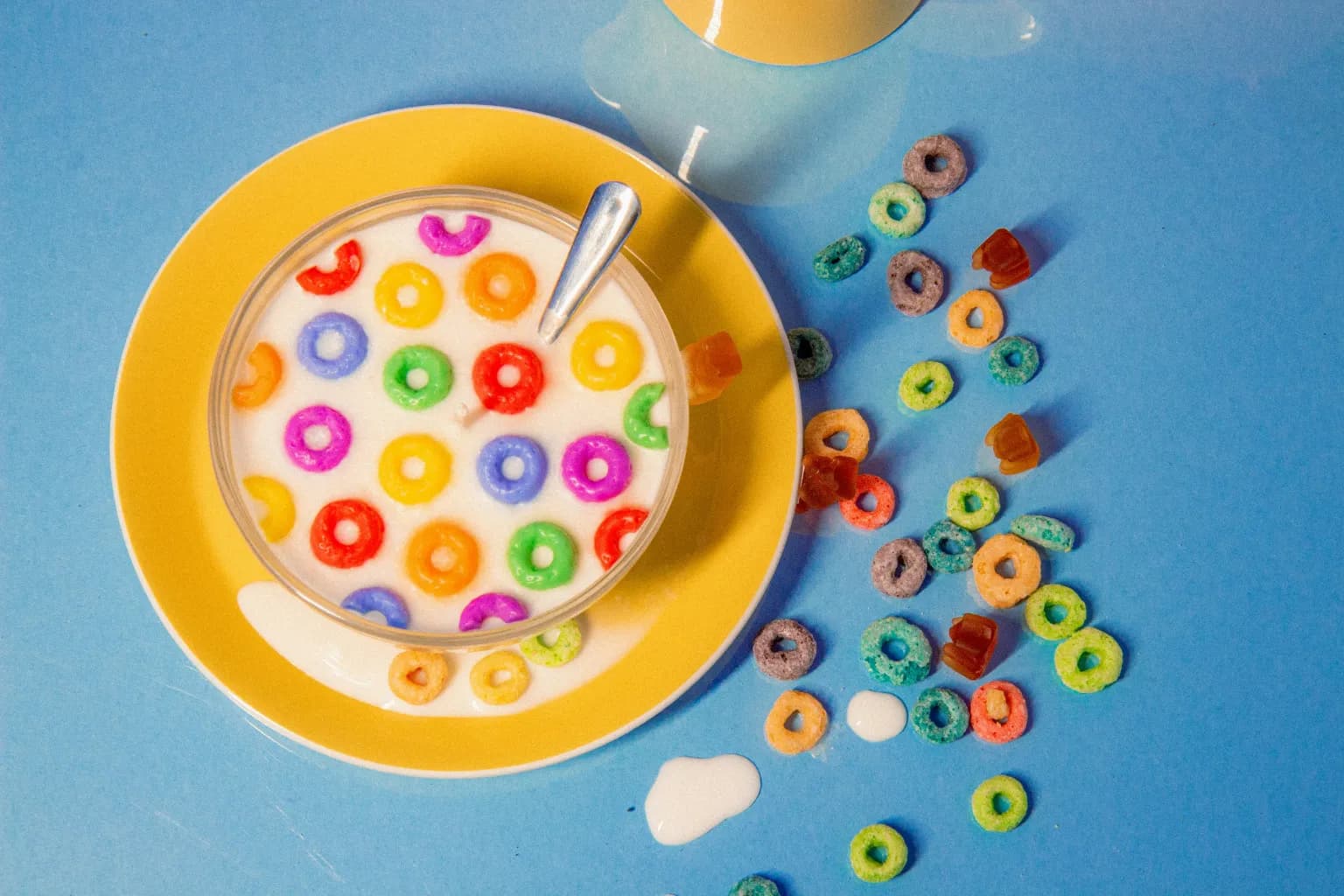
Image: Jessica Neves / Unsplash
Across party lines, Americans agree that artificial food dyes should be banned:
| Question | Would you support or oppose the following? |
| Item | Banning artificial food dyes |
| Response | Strongly or somewhat support |
| Poll Main Page | YouGov Survey: Policy Support (April 2025) |
| Interview Period | Mar. 28, 2025 to Apr. 1, 2025 |
| Sample Size | 1,095 |
| Earlier results | 1 earlier poll result [see all] |
| Policy Context | When this poll was conducted in late March 2025, U.S. Secretary of Health and Human Services Robert F. Kennedy Jr. had recently told food companies that the Trump administration wanted food dyes removed from their products. |
| Share Link | Food Dyes : YouGov, Apr. 1, 2025 |
Concern about artificial dyes goes back decades, but the U.S. Food and Drug Administration (FDA) has long maintained that approved artificial dyes are a safe part of the food system. As a result, artificial dyes are still in many products, especially breakfast cereals, candies, and snack foods.
But in April 2025, the FDA announced a plan to eliminate artificial dyes from the U.S. food system. Where did this turnabout come from, and what will happen next?
Artificial food dyes are laboratory-made color additives that give foods consistent, vibrant colors. By comparison, natural dyes come from ingredients such as beetroot (red), turmeric (yellow), and spirulina (blue-green). Natural dyes are often more expensive to produce and not as bright or consistent in their coloring.
Artificial food dyes have long been part of the American diet and remain in iconic products such as:
Froot Loops cereal (Red 40, Yellow 5, Blue 1, Yellow 6)
Gatorade sports drink, original lemon-lime flavor (Yellow 5)
Popsicle multi-flavor freezer pops (Red 40, Yellow 5, Blue 1)
Cheetos cheese puffs (Yellow 6, Yellow 5, and in some varieties Red 40 Lake and Yellow 6 Lake)
Many products like these emerged in the decades after World War II. It was the era of “better living through chemistry.” Technicolor-bright foods signaled innovation.
The 1960s counterculture and the 1970s environmentalist movement were suspicious of non-natural foods. In the mid-1970s, a symbol of that suspicion emerged: Red Dye Number 2 (Red 2). Studies with laboratory rats linked Red 2 to cancer. The studies used questionable methods and unrealistically high doses, but they triggered a media frenzy and a cultural moment. Under pressure, the FDA banned Red 2 in 1976.
Later research did not substantiate a link between Red 2 and cancer. But in the meantime, Red 2 was permanently removed from the food system. And famously, the Mars company removed the red candies from M&Ms for more than ten years, even though they never used Red 2. This was a sign of how much the “red scare” over Red 2 shaped public perception. The culture was increasingly receptive to narratives about hidden dangers in artificial food ingredients.
Although science linking artificial dyes to cancer did not hold up, it was already starting to be replaced with a new theory. In the early 1970s, pediatric allergist Benjamin Feingold proposed that foods with artificial colors, flavors, and preservatives could trigger hyperactivity in children. He popularized his theory as the “The Feingold Diet,” which eliminated these ingredients.
This surge of popular interest prompted researchers to study whether artificial ingredients affected children’s behavior. The research effort grew from the 1980s onward as ADHD (attention-deficit/hyperactivity disorder) became a formal diagnosis, and interest in its possible causes increased.
The first major synthesis of this research came in a 2011 FDA review. It concluded there was not enough evidence to claim artificial food dyes caused hyperactivity for most children, though a small subset might be sensitive to certain dyes. Early studies were hard to interpret because eliminating dyed foods also eliminated many sugary, highly processed foods. Later, more controlled trials held sugar constant and found that any dye-specific effect was small and limited to a minority of children.
Based on this review, the FDA rejected advocates’ calls for bans or warning labels. Research has continued since then, with the same general finding: the isolated effect of dyes exists, but it is small and confined to a subset of children.
A parallel story had taken place in Europe, with a different result. Although the European Food Safety Authority concluded there was not enough evidence to draw a causal link between specific food dyes and hyperactivity, the European Union (EU) still adopted a precautionary policy: Beginning in 2010, foods containing six widely used artificial dyes were required to carry a label stating they “may have an adverse effect on activity and attention in children.” Rather than include the label, many companies opted to replace these dyes with natural alternatives.
Having reached the same scientific conclusions, the EU and the United States responded differently because of different approaches to risk. In the EU, suspicion of possible harm can be enough to cause regulatory action. In the United States, regulators usually wait for clearer evidence of harm before intervening.
In 2025, the United States flipped its position. Leading the charge was newly appointed Secretary of Health and Human Services (HHS) Robert F. Kennedy, a long-time critic of artificial food dyes. At his direction, HHS and its subagency the FDA announced in April 2025 “a series of new measures to phase out all petroleum-based synthetic dyes from the nation’s food supply.” (“All petroleum-based synthetic dyes” means the popular artificial dyes that have been used and studied for decades.)
In its current form, the FDA plan is not a ban. Rather, it is an “understanding” with manufacturers, backed by the threat that if manufacturers do not comply, the FDA would undertake a ban.
In August 2025, HHS established a progress tracker for food manufacturers that have pledged compliance between 2026 and 2028. The tracker includes American food giants General Mills, Hershey, Kellogg, Kraft Heinz, Mars, and Pepsico. Although many companies in the tracker have committed to eliminating artificial dyes from all their products, some companies’ commitments appear limited to offering no-artificial-dye alternatives alongside their products that use artificial dyes.
Prior to the rise of Kennedy as HHS Secretary in the second Trump administration, regulating the color of food would not have been high on a typical Republican administration’s agenda. But as with HHS’s changes to vaccine policy, which we covered previously, Kennedy has diverged from long-standing institutional positions in favor of long-standing personal ones.
With vaccines, Kennedy moved HHS toward skepticism that runs against both public opinion and the scientific consensus. With artificial food dyes, he at least has public opinion on his side. And while the science does not support a ban, the evidence is more ambiguous than in the case of vaccines. But whereas European politicians used the ambiguity to justify warning labels, Kennedy went straight to a de facto ban.
Given Kennedy’s unusual approach, especially in the context of a Republican administration, the obvious question is: Will the artificial food dye policy be reversed again when Kennedy departs?
The policy—or technically, the “understandings”—may be changed, but that may not matter. The momentum toward phasing out artificial dyes has other drivers independent of Kennedy.
Although Kennedy’s efforts have gotten much more attention, some states have recently been moving in the same direction:
Virginia, West Virginia, Utah, and California have announced bans on several artificial dyes in school meals.
West Virginia’s ban is set to expand to all food sales statewide in January 2028.
Texas passed a law requiring warning labels on foods containing any of 40 artificial colors or flavors.
An additional twenty states, red and blue, are considering legislation to regulate artificial food dyes in one way or another.
When blue California and red Texas are independently moving toward tighter rules on artificial additives, something interesting is happening. Red states are at least partially motivated by Kennedy’s “Make America Healthy Again” (MAHA) push. But now that governors and legislators in places like West Virginia and Texas have publicly claimed that regulating artificial dyes is necessary to “protect kids,” the resulting laws are unlikely to disappear if MAHA fades. And for national brands, the strictest state laws—especially from large states—may end up functioning as a de facto national standard, even if federal policy later softens.
So even if FDA policy reverses course, the shift away from artificial dyes may keep moving on its own momentum. With broad public support and a growing number of states taking action, the MAHA moment may be the tipping factor for a bipartisan change that was waiting to happen.